
CORVIDS
The Literature Review (LR) Essay is a short essay written to inform the reader about types of research being done on a designated species. It is an essay written to help get the reader into the field before introducing a problem and a possible solution(s) in the Advocacy Project. It covers three different research studies on the species and helps explain it to the audience and relate them to each other.
From the LR Essay
Arrangement of Evidence
The presentation of evidence is arranged coherently and demonstrates a well-documented analytical synthesis.
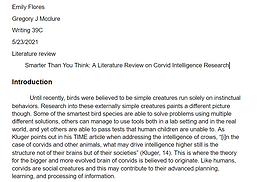
The very first thing I did was fix the formatting on my paper. I made sure everything fit under a category so then I would have an easier time staying on track and keeping all the information contained under one single point. I got this idea from one of the people I peer reviewed, and I did something similar, except I made my font bigger and bolded so it was more noticeable. I have a total of five section headings: "Introduction", "Tool Usage and Delayed Gratification", "Cognitive Reasoning and Planning", "The Mark Test", "Conclusion".
I also added a two-part title and a header to make my paper much more professional for viewing.
Before

After
Historical Dimensions
Historical aspects deepen the relevance of the studies being reviewed, enhancing the reader’s understanding of the conversation.
I wasn't too sure if I should include more sources than I already had, but I wanted to further expand on past research done on corvid populations. I remembered learning about John Marzluff, a very notable name in the scientific community for corvid research, and so I wrote about one of his famous studies in the introduction, just to catch the attention of the reader. I wanted to relate the reader more to the information and really open their mind to the concept of corvids being much more intelligent than what we gave them credit for. Since I wasn't using Marzluff as one of my big three sources, I didn't think to make a section specifically for his study, though I may come back to it in my Advocacy Project (AP) if necessary.
After
Before


Source Use and Integration
Sources are seamlessly integrated into the composition.
I focused more on trying to paraphrase and use my own words to explain the research done, but I decided to go back and add more citations and credit the authors as well. In each section of research I added citations to close off the paragraphs since I already did most of the explaining in the middle of the paragraph. I wanted to use more words from the research to further push my point, and I got these quotes from the discussion section in each of the sources. This ensured I was using the words of what the researchers concluded after their experiment was over and their data was in order.
After
Before


From the AP Essay
Multi-Modal Element
Uses at least one multi-modal element (image, chart, video, screenshot of a tweet, etc) that strengthens and deepens explanations, summaries, and/or arguments.
I wasn't sure what to use for my multi-modal element since all of the studies had very informative charts and graphs. But since I wanted to stick more with making an argument rather than summarizing data, I decided to go with an illustration from a study that measured how crows did against the "mark test". I think it helps show that crows are smarter than we think they are, and I included this while writing my AP essay. (The before photo is what I have written, and then after is the illustration I added below this paragraph.)
Before
After


Philosophical Questions, Rhetorical Appeals Counterargument
Uses philosophical questions and logical appeals to develop the argument as appropriate for a scholarly audience.
I really liked this paragraph, though I originally did not think to put it in. It combines information from the studies and foreshadows what I will be writing about in the solutions part of my essay. I keep it as professional as possible while also appealing to pathos, and I think overall it helps the reader start to question what they thought they knew about corvids and their world view in general.
Before
After
None

Structure
The structure of the overall essay and within each section is logical and there is coherence between the sections.
I continued to add more headings in order to make everything flow smoothly together. I wanted to make sure the reader was never wondering what section they were on, and if someone was skimming through the headings, they would be able to get the general idea of what they could expect from each section. I also added the infographic I made a while back since educating the general public on how to help corvids also happened to be one of my solutions in the AP essay. I think it adds a nice touch, and rather than take up a whole page solely for the infographic, I instead wove it into my paper and wrapped the text around it. I think it looks really nice where it is, and it is located in the solutions page since that is what it is ended to be.
Before
After

